

News
On November 20, the Chengdu-Chongqing Integrated Circuit 2025 Development Forum and the 31st Integrated Circuit Design Industry Exhibition (ICCAD-Expo 2025), themed "Chengdu-Chongqing Shared Core, Resonating Together," grandly opened at the Chengdu Western China International Expo City. Professor Wei Shaojun, Chairman of the Integrated Circuit Design Branch of the China Semiconductor Industry Association, delivered a keynote report titled "Technological Innovation Drives Design Industry Upgrading."
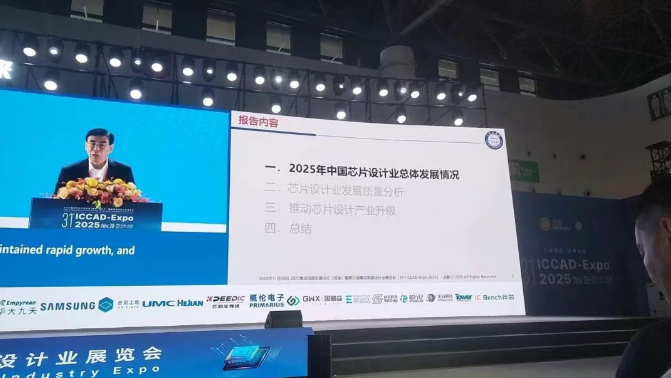
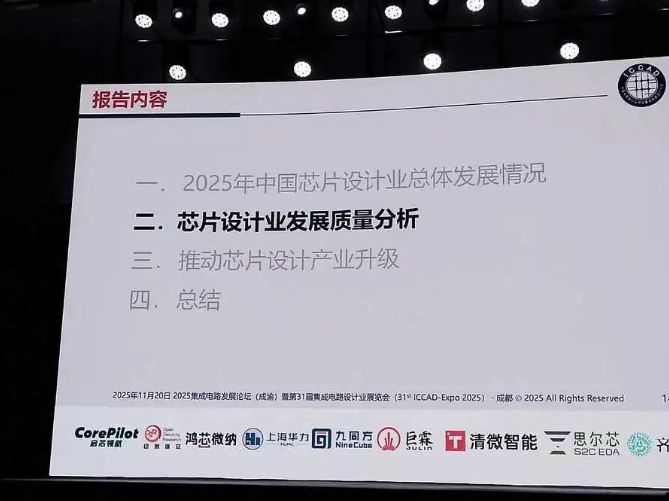
Professor Wei Shaojun introduced the development of China's chip design industry from three aspects: the overall development status in 2025, the analysis of development quality, and strategies to promote industrial upgrading. He concluded with a summary of his presentation.
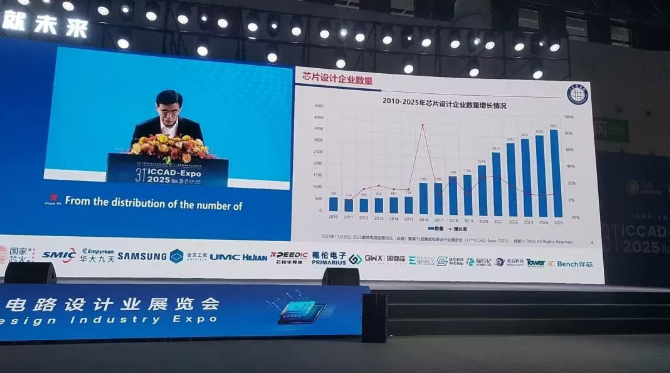
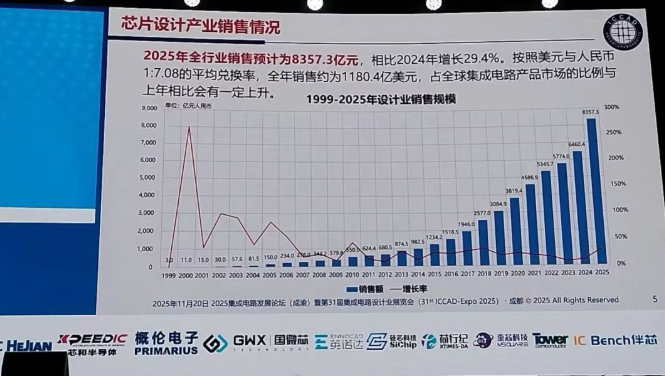
Professor Wei Shaojun pointed out that in 2025, the number of Chinese chip design companies reached 3,901. In terms of sales scale, the industry's total sales are expected to reach 835.73 billion RMB, a 29.4% increase compared to 2024. Based on an average exchange rate of 1 USD to 7.08 RMB, the annual sales amount to approximately 118.04 billion USD, with a certain rise in the proportion of the global integrated circuit product market compared to the previous year.
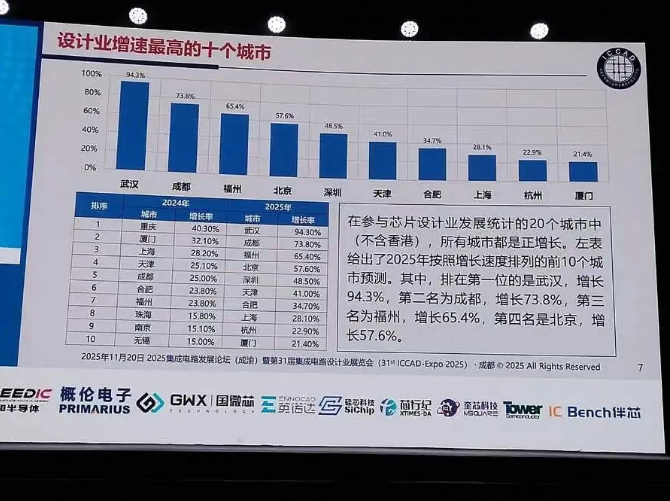
From a regional perspective, among the 20 cities participating in the chip design industry development statistics (excluding Hong Kong), all cities achieved positive growth. The table below lists the top 10 cities ranked by growth rate in 2025. Among them, Wuhan ranks first with 94.3% growth, followed by Chengdu with 73.8%, Fuzhou with 65.4%, and Beijing with 57.6%.

Regarding the sales of design enterprises, Professor Wei Shaojun noted that in 2025, it is expected that 831 companies will achieve sales exceeding 100 million RMB, an increase of 100 companies compared to 731 in 2024, with a growth rate of 13.7%.

In terms of employee scale, in 2025, 39 companies had over 1,000 employees, an increase of 7 compared to the previous year; 60 companies had 500–1,000 employees, an increase of 9; and 427 companies had 100–500 employees, an increase of 101 compared to 356 in the previous year. However, 86.5% of the total number of enterprises are small and micro-sized with fewer than 100 employees, totaling 3,375. Overall, small and micro-sized enterprises still constitute the vast majority.
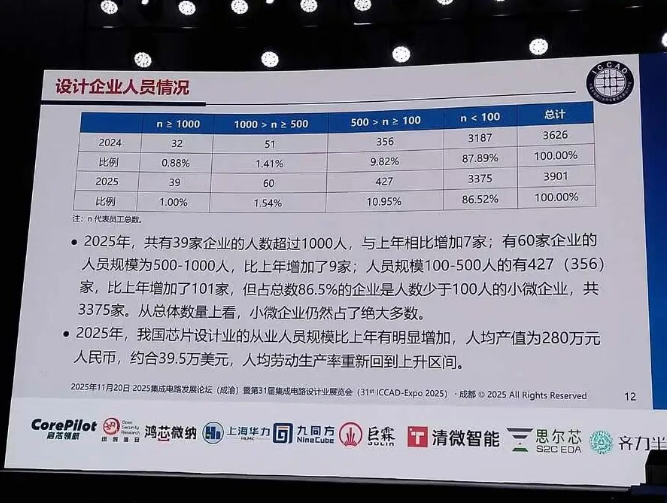
In 2025, the total workforce in China's chip design industry increased significantly compared to the previous year, with per capita output value reaching 2.8 million RMB, approximately 395,000 USD, indicating a return to rising labor productivity.
China's Chip Design Industry Has Returned to High-Speed Growth
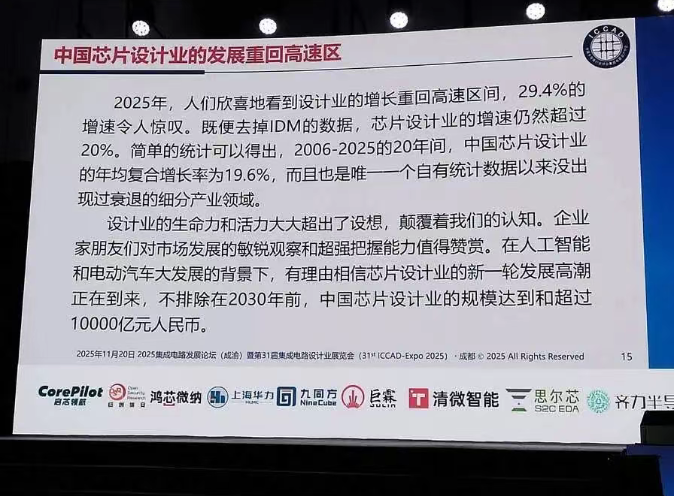
Professor Wei Shaojun emphasized that in 2025, the industry's growth has returned to a high-speed trajectory, with a remarkable growth rate of 29.4%. Even excluding IDM data, the growth rate of the chip design industry still exceeds 20%. Simple statistics show that over the 20 years from 2006 to 2025, the compound annual growth rate of China's chip design industry was 19.6%, making it the only sub-sector that has never experienced a recession since records began.
The vitality and dynamism of the design industry have far exceeded expectations, challenging our perceptions. The keen insights and strong grasp of market development by entrepreneurs deserve appreciation. Against the backdrop of rapid advancements in artificial intelligence and electric vehicles, there is reason to believe that a new wave of growth in the chip design industry is approaching. It is possible that by 2030, the scale of China's chip design industry will reach or exceed 10 trillion RMB.
The Issues of Small, Scattered, and Weak Chip Design Enterprises Have Not Been Fundamentally Resolved
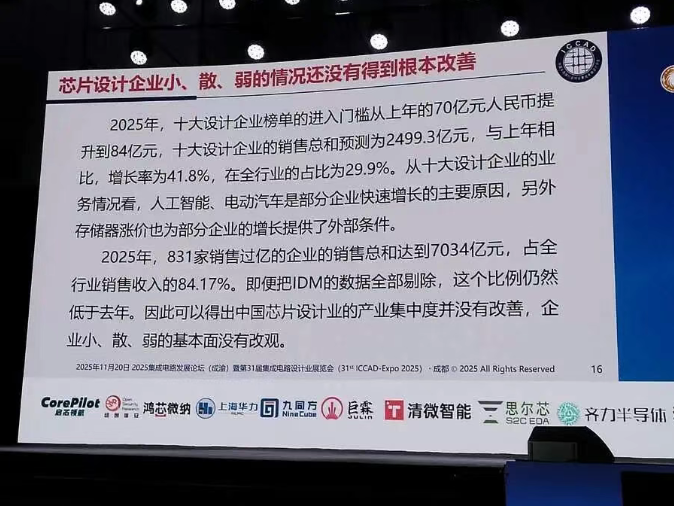
In 2025, the entry threshold for the top 10 design enterprises increased from 7 billion RMB the previous year to 8.4 billion. The combined sales of the top 10 design enterprises are expected to reach 249.93 billion RMB, a 41.8% increase compared to the previous year, accounting for 29.9% of the industry's total sales. From the business performance of the top 10 design enterprises, artificial intelligence and electric vehicles are the main drivers of rapid growth for some companies, while rising memory chip prices have also provided external conditions for growth for others.
In 2025, the combined sales of the 831 enterprises with sales exceeding 100 million RMB reached 703.4 billion RMB, accounting for 84.17% of the industry's total sales revenue. Even after excluding all IDM data, this proportion remains lower than last year. Therefore, it can be concluded that the industrial concentration of China's chip design industry has not improved, and the fundamental issues of small, scattered, and weak enterprises persist.
Product Levels Remain Low, Concentrated in Mid-to-Low End
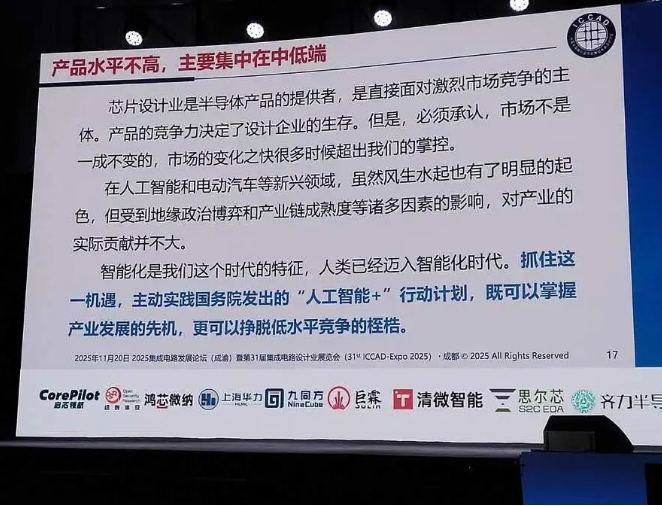
The chip design industry is the provider of semiconductor products and the main entity facing fierce market competition. The competitiveness of products determines the survival of design enterprises. However, it must be acknowledged that the market is not static; its changes often exceed our control.
In emerging fields such as artificial intelligence and electric vehicles, although progress has been made, the actual contribution to the industry is limited due to factors like geopolitical disputes and the maturity of the industrial chain.
Intelligence is the defining feature of our era, as humanity has entered the age of intelligence. Seizing this opportunity and actively implementing the State Council's "AI+" action plan can not only capture the initiative in industrial development but also break free from the constraints of low-level competition.
High Costs Are an Unavoidable Contradiction
The aftermath of the talent war in 2023, which led to a significant increase in labor costs, continues to linger. Particularly in the past two years, the rapid development of artificial intelligence has, on one hand, provided sustainable opportunities for many entrepreneurs, and on the other, attracted substantial capital inflows. Currently, the impact of high costs on AI enterprises is not yet fully apparent, but it will gradually emerge as products enter the market or companies go public. Therefore, the task of reducing costs is urgent.
It is recommended that enterprises:
Improve labor productivity to share high costs through increased output.
Enhance product competitiveness to offset the negative effects of high costs with high profit margins. Cost reduction is an eternal theme for enterprises, and chip design companies must address this with urgency. Early planning is necessary for development and to ensure sustainable growth.
The Road to Combating "Involution" Is Long
We have observed that the government has clearly expressed opposition to "involution." However, the phenomenon has not disappeared and has even intensified in some areas. The root cause lies in the persistence of the conditions that foster "involution," and the factors driving it have not vanished. On one hand, we call for creating a favorable development environment, including industrial and policy environments, to eliminate "involution." However, it should be noted that the main reason for the persistence of "involution" lies within ourselves. The key to solving the problem is to follow market laws and allow enterprises that should exit to leave.
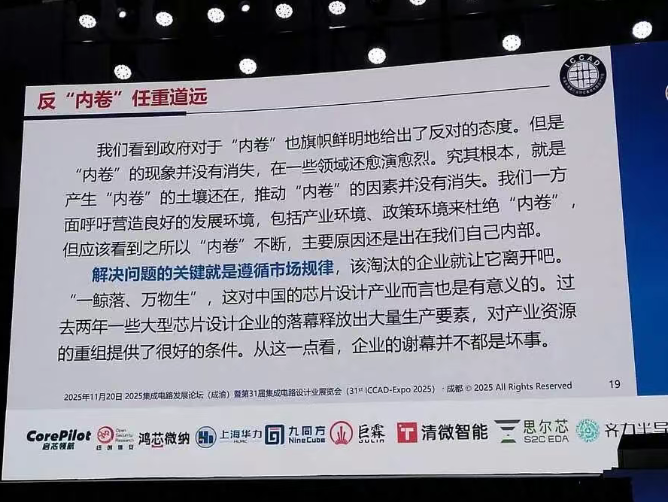
"Whale fall, all things thrive"—this holds significance for China's chip design industry. The closure of some large chip design enterprises in the past two years has released a large amount of production factors, providing favorable conditions for the reorganization of industrial resources. From this perspective, the exit of enterprises is not always a bad thing.
Subsequently, Professor Wei Shaojun elaborated on how to promote the upgrading of the chip design industry from four aspects: funding, talent, market, and other issues.
Regarding Funding Issues
The trend of investment entities becoming quasi-state-owned. Many investment funds, while seemingly operated by market entities, are largely backed by state capital or government funds. Under the pressure to preserve and increase the value of state-owned assets, these investors often exert significant influence on fund managers.
Non-market interventions in fund operations. Some state-owned investors often set up a "one-vote veto" in the fund management system.
We call for further improvement of the semiconductor investment system and mechanisms, establishing multi-layered, more market-oriented investment funds to ensure the availability of market-driven investors. On the other hand, as invested enterprises, it is essential to recognize their own capabilities, avoid unrealistic valuations, and demonstrate professionalism to reassure investors.
Regarding Talent Issues
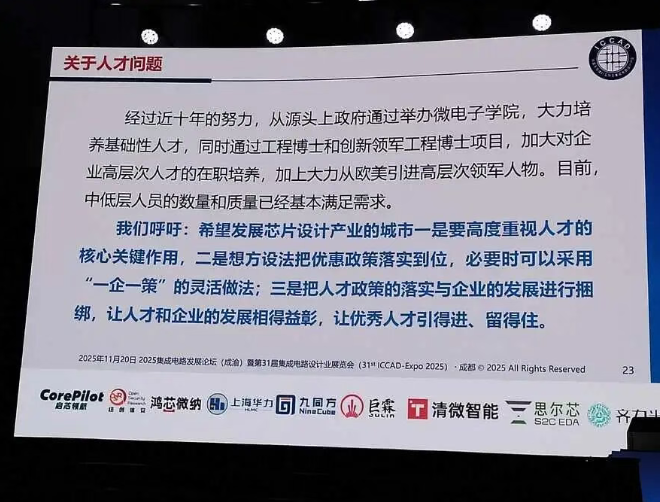
After nearly a decade of efforts, the government has fundamentally addressed the issue by establishing microelectronics schools to cultivate foundational talent. Simultaneously, through engineering doctoral and innovation leadership doctoral programs, efforts have been made to enhance the training of high-level talent within enterprises, coupled with the active recruitment of high-level leaders from Europe and the United States. Currently, the quantity and quality of mid-to-low-level personnel have largely met the demand.
We call on cities aiming to develop the chip design industry to:
Highly prioritize the core role of talent.
Strive to implement preferential policies effectively, adopting flexible approaches such as "one enterprise, one policy" when necessary.
Link the implementation of talent policies with enterprise development, ensuring mutual benefits and enabling the attraction and retention of outstanding talent.
Regarding Market Issues
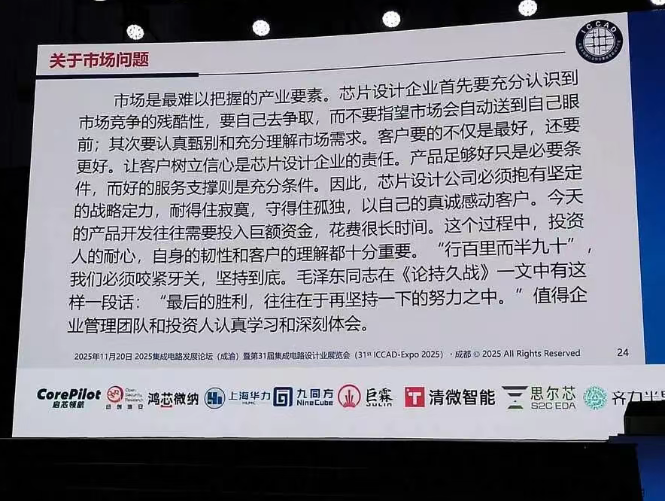
The market is the most challenging industrial factor to grasp. Chip design enterprises must first fully recognize the harshness of market competition and proactively strive for opportunities rather than expecting the market to come to them. Second, they must carefully identify and fully understand market demands.
Customers not only want the best but also better. It is the responsibility of chip design enterprises to build customer confidence. Excellent products are a necessary condition, while strong service support is a sufficient condition. Therefore, chip design companies must maintain firm strategic determination, endure solitude, and win customers with sincerity.
Today, product development often requires substantial investment and long periods. During this process, the patience of investors, the resilience of the enterprise, and the understanding of customers are all crucial. "The last ten miles of a hundred-mile journey are the hardest." We must grit our teeth and persevere to the end.
As Comrade Mao Zedong stated in On Protracted War: "Often, final victory lies in the effort to persist a little longer." This is worth careful study and deep reflection by enterprise management teams and investors.
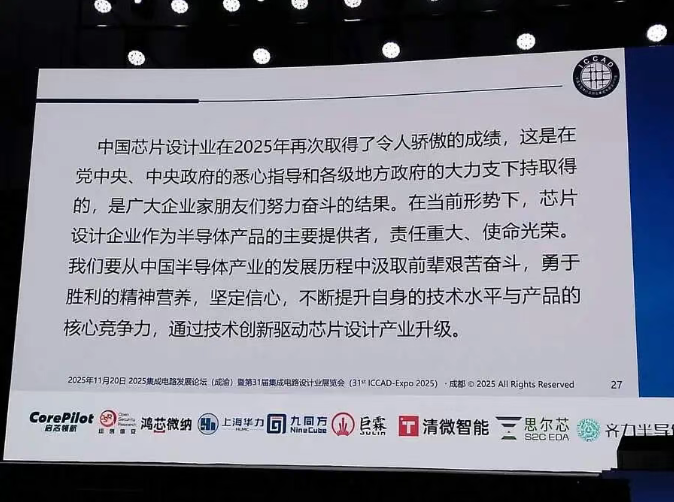
In conclusion, Professor Wei Shaojun summarized that China's chip design industry achieved remarkable results again in 2025, thanks to the careful guidance of the Party Central Committee and the central government, as well as the strong support of local governments at all levels. This is the result of the hard work of entrepreneurs.
In the current context, chip design enterprises, as the main providers of semiconductor products, bear significant responsibilities and a glorious mission. We must draw inspiration from the hardworking and victorious spirit of our predecessors in the development of China's semiconductor industry, strengthen our confidence, continuously improve our technical capabilities and product competitiveness, and drive the upgrading of the chip design industry through technological innovation.
END


